Please Scroll Down to See Forums Below
napsgear
genezapharmateuticals
domestic-supply
puritysourcelabs
UGL OZ
UGFREAK
napsgeargenezapharmateuticals domestic-supplypuritysourcelabsUGL OZUGFREAK

So What Do You Think About Romney's Taxes Being Stolen

Staples had one (US) location when Mitt convinced Bain Capital to invest in it. Now they have over 1500 in the US and over 2200 worldwide. They employ 90,000+ worldwide, including Canada. You can thank Mitt for that. Domino's Pizza employs 145,000 worldwide, including Canada too...but mostly US. Sports Authority got started with some Bain Capital money too.

Those businesses are all still open. So are Brookstone, Sealy, AMC Theaters, Michaels, Toys R Us, Burger King, Burlington Coat Factory, Clear Channel Communications, Guitar Center, Gymboree and several others.

Out of the two evils, I think Romney is our better bet. He has done a good job with multiple businesses, a good job with the winter olympics in Utah, and a good job as gov. of Mass. Of course he would be very limited by congress as POTUS and probably not be able to get much done. But that goes for any POTUS. Now...what to do about all those worthless congresspeople?

And most of those companies have a corporate culture of raping the employees. They are jobs, but they're not good places to work. For example, I know a lot of people who have worked at Guitar Center, some in management. When Bain took over, they slashed staff, slashed benefits, and started screwing salespeople on commissions. It's worse for managers, since they're expected to work lots of extra hours with no overtime, and frequently forfeit commissions. They also took away the managers' ability to negotiate price, and haggling is an expected part of the music business.

I've heard similar stories from Staples and Sports Authority.
 
You mean proven photoshopped birth certificate released half-assed after 2 years of refusing to even though it's supposedly so much simpler to release tax info? Oh ya ...that doesn't count. If you think I'm incredible because I believe in life on other planets then you're just as arrogant as I thought... Not to mention stupid.

LOL man nothing you said is true. NOTHING!


I usually don't bother arguing with birthers just because it is so far beyond ridiculous, but since I like you Jack, I'm going to clue you in on some facts:

FactCheck.org : Born in the U.S.A.

And then

FactCheck.org : Indeed, Born in the U.S.A.
 
LOL man nothing you said is true. NOTHING!


I usually don't bother arguing with birthers just because it is so far beyond ridiculous, but since I like you Jack, I'm going to clue you in on some facts:

FactCheck.org : Born in the U.S.A.

And then

FactCheck.org : Indeed, Born in the U.S.A.

LOL @ "facts". Facts don't matter to the Right Wing anymore, they openly mock them.

"We're not going to let our campaign be dictated by fact-checkers," said Neil Newhouse, a Romney pollster.
 
Look at this way: if George Bush sr. Can get away with introducing cocaine to the USA, and George w. Bush can gr away with starting a war with Iraq for no goddamn reason... Then barrack Hussein Obama can sure as shit become president If he wasn't born in America. It's such a double standard with liberals. Craziness. I suppose you're not aware that when Hawaii was first asked for obama's BC, they said they destroyed all of them way back in the day when they digitized everything. Then magically, UP pops the BC risen from the dead!
 
LOL @ "facts". Facts don't matter to the Right Wing anymore, they openly mock them.

Lol I'm not even a republican! I'm moderate. Barrack is just too off the charts to be okay. He's a fuck up. You should check your "facts" more carefully.
 
Look at this way: if George Bush sr. Can get away with introducing cocaine to the USA, and George w. Bush can gr away with starting a war with Iraq for no goddamn reason... Then barrack Hussein Obama can sure as shit become president If he wasn't born in America. It's such a double standard with liberals. Craziness. I suppose you're not aware that when Hawaii was first asked for obama's BC, they said they destroyed all of them way back in the day when they digitized everything. Then magically, UP pops the BC risen from the dead!


Aye Carumba man, you mock dB for saying that righties don't care about facts, then you prove his point by not reading my links :FRlol:

All that nonsense you are regurgitating is addressed in the factcheck articles. Read them and then see what you think. And if you don't trust factcheck (because denying facts and believing baseless bullshit is a common rightie tactic), then go find other sources because everything factcheck says in those articles is verifiable.

And birthers aren't moderate. They believe the most nonsensical lies in politics today, and don't bother educting themselves on any facts because they want to believe what they believe, without concern for truth. Nothing moderate about that.

So read those links. It won't take long. I'm just trying to help.
 
lol @ jack steel
 
headholio does!!! He says Romney is dodging his tax liabilities!


The "loopholes" are all legal though. So I guess you are saying rape is legal?

I don't have any problems with anyone skirting taxes in any LEGAL way possible, whether they are dem or repub. If it's legal, it's not "skirting" or "raping" as far as I'm concerned.

being a shitty president is legal too. being a lying d-bag who doesn't care about his country is also legal.

"it's legal" is a worthless defense when you're talking about a candidate for president, the ultimate PUBLIC servant
 
being a shitty president is legal too. being a lying d-bag who doesn't care about his country is also legal.

"it's legal" is a worthless defense when you're talking about a candidate for president, the ultimate PUBLIC servant

Why would anyone pay more than they're required in taxes? That's the ONLY defense needed.
 

A few comments even though I don't have time to get to into it right now:

-Your articles claim Clinton did "stuff" but not specifically anything about no-doc loans which was the topic. I think no-doc loans are unrelated to what is claimed in you articles.

I already acknowldeged that repeal of Glass - Steagal was wrong. It was signed by Clinton who was too happy to go long with Republicans who pushed for and passed this and other deregulation legislation. So I will agree Clinton did some dumb stuff, which is why we call him the best "republican" President we ever had.

Here is a good article about repubs pushing to deregulate the financial industry during Clinton's reign, particularly Phil Gramm (R) Texas.

http://www.nytimes.com/2008/11/17/business/economy/17gramm.html?pagewanted=all

The right wing whining about the Community reinvestment act as "the cause" of the meltdown has been thoroughly debunked. The CRA started in 1977, and was supported by all Presidents since then.

The Commission concludes the CRA was not a significant factor in subprime lending or the crisis. Many subprime lenders were not subject to the CRA. Research indicates only 6% of the high cost loans - a proxy for subprime loans - had any connection to the law. Loans made by CRA-regulated lenders in the neighborhoods in which they were required to lend were half as likely to default as similar loans made in the same neighborhoods by independent mortgage originators not subject to the law. [The Financial Crisis Inquiry Report, January 2011]

The fact that Clinton encouraged home ownership by a larger segment of the population makes him no different than Reagan, or Bush Sr, or Jr.

President Bush touted his goal Monday of boosting minority home ownership by 5.5 million before the end of the decade through grants to low-income families and credits to developers.

Bush aims to boost minority home ownership - CNN

If you look into any decent analysis of the cause of the financial meltdown, you will see hundreds of inter-related complex causes that tie together. Cherry picking one thing CLinton did or anyone else is more politics than truth.

But regardless of what Bush did or Reagan or Clinton did, we need to look at policy going forward, and Republicans are still pushing the kind of policy that caused the disaster (and that you are blaming Clinton for).
 
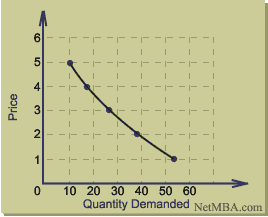
When you shift the demand curve to the left with artificially low interest rates what do you get?

demandcurve.gif


Here's a hint, people make them with gum.

Why is everyone ignoring me? :)
 
being a shitty president is legal too. being a lying d-bag who doesn't care about his country is also legal.

"it's legal" is a worthless defense when you're talking about a candidate for president, the ultimate PUBLIC servant

So, you don't take advantage of every deduction you possibly can to lower your tax burden? That's legal!

Do you only take certain deductions, but not all you could? That's legal too!

Do you pay as much in taxes as you possibly can?

Do you refuse to accept returns if you are due them (willingly and gladly overpay)?

Why is, "I took every legal tax deduction I was allowed." a worthless defense for a public servant of any kind? Or anyone else for that matter?

Seems like a perfect defense to me.

"Mr. ceo, you cheated on your taxes!"

"No sir, I took every legal tax deduction I was allowed."

"Oh, yes. I see that now. You certainly did. Case closed then."

Yes, worthless. You're right.
 
Too bad Ron Paul isn't the repub candidate.

Millions of 19 year olds who have never taken an econ course feel the same way.
 
A few comments even though I don't have time to get to into it right now:

-Your articles claim Clinton did "stuff" but not specifically anything about no-doc loans which was the topic. I think no-doc loans are unrelated to what is claimed in you articles.

I already acknowldeged that repeal of Glass - Steagal was wrong. It was signed by Clinton who was too happy to go long with Republicans who pushed for and passed this and other deregulation legislation. So I will agree Clinton did some dumb stuff, which is why we call him the best "republican" President we ever had.

Here is a good article about repubs pushing to deregulate the financial industry during Clinton's reign, particularly Phil Gramm (R) Texas.

http://www.nytimes.com/2008/11/17/business/economy/17gramm.html?pagewanted=all

The right wing whining about the Community reinvestment act as "the cause" of the meltdown has been thoroughly debunked. The CRA started in 1977, and was supported by all Presidents since then.


The fact that Clinton encouraged home ownership by a larger segment of the population makes him no different than Reagan, or Bush Sr, or Jr.


Bush aims to boost minority home ownership - CNN

If you look into any decent analysis of the cause of the financial meltdown, you will see hundreds of inter-related complex causes that tie together. Cherry picking one thing CLinton did or anyone else is more politics than truth.

But regardless of what Bush did or Reagan or Clinton did, we need to look at policy going forward, and Republicans are still pushing the kind of policy that caused the disaster (and that you are blaming Clinton for).

gramm-leach-blilely was a bi-partisan cluster fuck...
 
Yes it was. And notice that nothing has changed. If you want to criticize dems, there is a good reason. Even though repubs would probably fight any new regs, the dems aren't even pushing for them.

i'm not criticizing dems...i'm voicing my disdain for bill clinton...i hate the fact that everyone looks back on his time in office with this warm, fuzzy, afterglow...the problem with warm, fuzzy, afterglows is that generally you have to get FUCKED before you get to have one...and we did.
 
i'm not criticizing dems...i'm voicing my disdain for bill clinton...i hate the fact that everyone looks back on his time in office with this warm, fuzzy, afterglow...the problem with warm, fuzzy, afterglows is that generally you have to get FUCKED before you get to have one...and we did.

Kinda like Reagan in that respect.
 
i'm not criticizing dems...i'm voicing my disdain for bill clinton...i hate the fact that everyone looks back on his time in office with this warm, fuzzy, afterglow...the problem with warm, fuzzy, afterglows is that generally you have to get FUCKED before you get to have one...and we did.

Sounds like envy. :FRlol:
But I'm sure that someday a smart Republican will come along who could match wits with the likes of Clinton or Obama. There has to be one somewhere. There has to be! :lmao:
 
Sounds like envy. :FRlol:
But I'm sure that someday a smart Republican will come along who could match wits with the likes of Clinton or Obama. There has to be one somewhere. There has to be! :lmao:

envy? no way...clinton made lots of bad decisions...i think he sucked.

obama? he inherited such a deplorable bag of shit that it will be years before we are able to accurately assess whether he helped or harmed us...and i'll happily tip my hat to the man (or give him the finger) after all the cards are counted.
 
Millions of 19 year olds who have never taken an econ course feel the same way.
You could insert Obama voter in 2008 as well.
I've taken Micro and Macro at the undergrad level as well as Law and Economics at the grad level. Took me years of reading and education post college to understand the "Fatal Conceit" and the "Pretense of Knowledge."

Hayek's acceptance speech for the Nobel Prize.

The particular occasion of this lecture, combined with the chief practical problem which economists have to face today, have made the choice of its topic almost inevitable. On the one hand the still recent establishment of the Nobel Memorial Prize in Economic Science marks a significant step in the process by which, in the opinion of the general public, economics has been conceded some of the dignity and prestige of the physical sciences. On the other hand, the economists are at this moment called upon to say how to extricate the free world from the serious threat of accelerating inflation which, it must be admitted, has been brought about by policies which the majority of economists recommended and even urged governments to pursue. We have indeed at the moment little cause for pride: as a profession we have made a mess of things.

It seems to me that this failure of the economists to guide policy more successfully is closely connected with their propensity to imitate as closely as possible the procedures of the brilliantly successful physical sciences — an attempt which in our field may lead to outright error. It is an approach which has come to be described as the "scientistic" attitude — an attitude which, as I defined it some thirty years ago, "is decidedly unscientific in the true sense of the word, since it involves a mechanical and uncritical application of habits of thought to fields different from those in which they have been formed."[1] I want today to begin by explaining how some of the gravest errors of recent economic policy are a direct consequence of this scientistic error.

The theory which has been guiding monetary and financial policy during the last thirty years, and which I contend is largely the product of such a mistaken conception of the proper scientific procedure, consists in the assertion that there exists a simple positive correlation between total employment and the size of the aggregate demand for goods and services; it leads to the belief that we can permanently assure full employment by maintaining total money expenditure at an appropriate level. Among the various theories advanced to account for extensive unemployment, this is probably the only one in support of which strong quantitative evidence can be adduced. I nevertheless regard it as fundamentally false, and to act upon it, as we now experience, as very harmful.

This brings me to the crucial issue. Unlike the position that exists in the physical sciences, in economics and other disciplines that deal with essentially complex phenomena, the aspects of the events to be accounted for about which we can get quantitative data are necessarily limited and may not include the important ones. While in the physical sciences it is generally assumed, probably with good reason, that any important factor which determines the observed events will itself be directly observable and measurable, in the study of such complex phenomena as the market, which depend on the actions of many individuals, all the circumstances which will determine the outcome of a process, for reasons which I shall explain later, will hardly ever be fully known or measurable. And while in the physical sciences the investigator will be able to measure what, on the basis of a prima facie theory, he thinks important, in the social sciences often that is treated as important which happens to be accessible to measurement. This is sometimes carried to the point where it is demanded that our theories must be formulated in such terms that they refer only to measurable magnitudes.

It can hardly be denied that such a demand quite arbitrarily limits the facts which are to be admitted as possible causes of the events which occur in the real world. This view, which is often quite naively accepted as required by scientific procedure, has some rather paradoxical consequences. We know, of course, with regard to the market and similar social structures, a great many facts which we cannot measure and on which indeed we have only some very imprecise and general information. And because the effects of these facts in any particular instance cannot be confirmed by quantitative evidence, they are simply disregarded by those sworn to admit only what they regard as scientific evidence: they thereupon happily proceed on the fiction that the factors which they can measure are the only ones that are relevant.

The correlation between aggregate demand and total employment, for instance, may only be approximate, but as it is the only one on which we have quantitative data, it is accepted as the only causal connection that counts. On this standard there may thus well exist better "scientific" evidence for a false theory, which will be accepted because it is more "scientific," than for a valid explanation, which is rejected because there is no sufficient quantitative evidence for it.
As a profession, economists have made a mess of things.

Let me illustrate this by a brief sketch of what I regard as the chief actual cause of extensive unemployment — an account which will also explain why such unemployment cannot be lastingly cured by the inflationary policies recommended by the now fashionable theory. This correct explanation appears to me to be the existence of discrepancies between the distribution of demand among the different goods and services and the allocation of labor and other resources among the production of those outputs. We possess a fairly good "qualitative" knowledge of the forces by which a correspondence between demand and supply in the different sectors of the economic system is brought about, of the conditions under which it will be achieved, and of the factors likely to prevent such an adjustment. The separate steps in the account of this process rely on facts of everyday experience, and few who take the trouble to follow the argument will question the validity of the factual assumptions, or the logical correctness of the conclusions drawn from them. We have indeed good reason to believe that unemployment indicates that the structure of relative prices and wages has been distorted (usually by monopolistic or governmental price fixing), and that to restore equality between the demand and the supply of labor in all sectors changes of relative prices and some transfers of labor will be necessary.

But when we are asked for quantitative evidence for the particular structure of prices and wages that would be required in order to assure a smooth continuous sale of the products and services offered, we must admit that we have no such information. We know, in other words, the general conditions in which what we call, somewhat misleadingly, an equilibrium will establish itself; but we never know what the particular prices or wages are which would exist if the market were to bring about such an equilibrium. We can merely say what the conditions are in which we can expect the market to establish prices and wages at which demand will equal supply. But we can never produce statistical information which would show how much the prevailing prices and wages deviate from those which would secure a continuous sale of the current supply of labor. Though this account of the causes of unemployment is an empirical theory — in the sense that it might be proved false, e.g., if, with a constant money supply, a general increase of wages did not lead to unemployment — it is certainly not the kind of theory which we could use to obtain specific numerical predictions concerning the rates of wages, or the distribution of labor, to be expected.

Why should we, however, in economics, have to plead ignorance of the sort of facts on which, in the case of a physical theory, a scientist would certainly be expected to give precise information? It is probably not surprising that those impressed by the example of the physical sciences should find this position very unsatisfactory and should insist on the standards of proof which they find there. The reason for this state of affairs is the fact, to which I have already briefly referred, that the social sciences, like much of biology but unlike most fields of the physical sciences, have to deal with structures of essential complexity, i.e., with structures whose characteristic properties can be exhibited only by models made up of relatively large numbers of variables. Competition, for instance, is a process which will produce certain results only if it proceeds among a fairly large number of acting persons.

In some fields, particularly where problems of a similar kind arise in the physical sciences, the difficulties can be overcome by using, instead of specific information about the individual elements, data about the relative frequency, or the probability, of the occurrence of the various distinctive properties of the elements. But this is true only where we have to deal with what has been called by Dr. Warren Weaver (formerly of the Rockefeller Foundation), with a distinction which ought to be much more widely understood, "phenomena of unorganized complexity," in contrast to those "phenomena of organized complexity" with which we have to deal in the social sciences.[2]

Organized complexity here means that the character of the structures showing it depends not only on the properties of the individual elements of which they are composed, and the relative frequency with which they occur, but also on the manner in which the individual elements are connected with each other. In the explanation of the working of such structures we can for this reason not replace the information about the individual elements by statistical information, but require full information about each element if from our theory we are to derive specific predictions about individual events. Without such specific information about the individual elements we shall be confined to what on another occasion I have called mere pattern predictions — predictions of some of the general attributes of the structures that will form themselves, but not containing specific statements about the individual elements of which the structures will be made up.[3]

This is particularly true of our theories accounting for the determination of the systems of relative prices and wages that will form themselves on a well-functioning market. Into the determination of these prices and wages there will enter the effects of particular information possessed by every one of the participants in the market process — a sum of facts which in their totality cannot be known to the scientific observer, or to any other single brain. It is indeed the source of the superiority of the market order, and the reason why, when it is not suppressed by the powers of government, it regularly displaces other types of order, that in the resulting allocation of resources more of the knowledge of particular facts will be utilized which exists only dispersed among uncounted persons, than any one person can possess. But because we, the observing scientists, can thus never know all the determinants of such an order, and in consequence also cannot know at which particular structure of prices and wages demand would everywhere equal supply, we also cannot measure the deviations from that order; nor can we statistically test our theory that it is the deviations from that "equilibrium" system of prices and wages which make it impossible to sell some of the products and services at the prices at which they are offered.
"This failure of the economists to guide policy more successfully is closely connected with their propensity to imitate as closely as possible the procedures of the brilliantly successful physical sciences."

Before I continue with my immediate concern, the effects of all this on the employment policies currently pursued, allow me to define more specifically the inherent limitations of our numerical knowledge which are so often overlooked. I want to do this to avoid giving the impression that I generally reject the mathematical method in economics. I regard it in fact as the great advantage of the mathematical technique that it allows us to describe, by means of algebraic equations, the general character of a pattern even where we are ignorant of the numerical values which will determine its particular manifestation. We could scarcely have achieved that comprehensive picture of the mutual interdependencies of the different events in a market without this algebraic technique. It has led to the illusion, however, that we can use this technique for the determination and prediction of the numerical values of those magnitudes; and this has led to a vain search for quantitative or numerical constants. This happened in spite of the fact that the modern founders of mathematical economics had no such illusions. It is true that their systems of equations describing the pattern of a market equilibrium are so framed that if we were able to fill in all the blanks of the abstract formulae, i.e., if we knew all the parameters of these equations, we could calculate the prices and quantities of all commodities and services sold. But, as Vilfredo Pareto, one of the founders of this theory, clearly stated, its purpose cannot be "to arrive at a numerical calculation of prices," because, as he said, it would be "absurd" to assume that we could ascertain all the data.[4] Indeed, the chief point was already seen by those remarkable anticipators of modern economics, the Spanish schoolmen of the 16th century, who emphasized that what they called pretium mathematicum, the mathematical price, depended on so many particular circumstances that it could never be known to man but was known only to God.[5] I sometimes wish that our mathematical economists would take this to heart. I must confess that I still doubt whether their search for measurable magnitudes has made significant contributions to our theoretical understanding of economic phenomena — as distinct from their value as a description of particular situations. Nor am I prepared to accept the excuse that this branch of research is still very young: Sir William Petty, the founder of econometrics, was after all a somewhat senior colleague of Sir Isaac Newton in the Royal Society!

There may be few instances in which the superstition that only measurable magnitudes can be important has done positive harm in the economic field: but the present inflation and employment problems are a very serious one. Its effect has been that what is probably the true cause of extensive unemployment has been disregarded by the scientistically minded majority of economists, because its operation could not be confirmed by directly observable relations between measurable magnitudes, and that an almost exclusive concentration on quantitatively measurable surface phenomena has produced a policy which has made matters worse.

It has, of course, to be readily admitted that the kind of theory which I regard as the true explanation of unemployment is a theory of somewhat limited content because it allows us to make only very general predictions of the kind of events which we must expect in a given situation. But the effects on policy of the more ambitious constructions have not been very fortunate and I confess that I prefer true but imperfect knowledge, even if it leaves much indetermined and unpredictable, to a pretence of exact knowledge that is likely to be false. The credit which the apparent conformity with recognized scientific standards can gain for seemingly simple but false theories may, as the present instance shows, have grave consequences.

In fact, in the case discussed, the very measures which the dominant "macroeconomic" theory has recommended as a remedy for unemployment — namely, the increase of aggregate demand — have become a cause of a very extensive misallocation of resources which is likely to make later large-scale unemployment inevitable. The continuous injection of additional amounts of money at points of the economic system where it creates a temporary demand which must cease when the increase of the quantity of money stops or slows down, together with the expectation of a continuing rise of prices, draws labor and other resources into employments which can last only so long as the increase of the quantity of money continues at the same rate — or perhaps even only so long as it continues to accelerate at a given rate. What this policy has produced is not so much a level of employment that could not have been brought about in other ways, as a distribution of employment which cannot be indefinitely maintained and which after some time can be maintained only by a rate of inflation which would rapidly lead to a disorganization of all economic activity. The fact is that by a mistaken theoretical view we have been led into a precarious position in which we cannot prevent substantial unemployment from reappearing; not because, as this view is sometimes misrepresented, this unemployment is deliberately brought about as a means to combat inflation, but because it is now bound to occur as a deeply regrettable but inescapable consequence of the mistaken policies of the past as soon as inflation ceases to accelerate.

I must, however, now leave these problems of immediate practical importance which I have introduced chiefly as an illustration of the momentous consequences that may follow from errors concerning abstract problems of the philosophy of science. There is as much reason to be apprehensive about the long-run dangers created in a much wider field by the uncritical acceptance of assertions which have the appearance of being scientific as there is with regard to the problems I have just discussed. What I mainly wanted to bring out by the topical illustration is that certainly in my field, but I believe also generally in the sciences of man, what looks superficially like the most scientific procedure is often the most unscientific, and, beyond this, that in these fields there are definite limits to what we can expect science to achieve. This means that to entrust to science — or to deliberate control according to scientific principles — more than scientific method can achieve may have deplorable effects. The progress of the natural sciences in modern times has of course so much exceeded all expectations that any suggestion that there may be some limits to it is bound to arouse suspicion. Especially all those will resist such an insight who have hoped that our increasing power of prediction and control, generally regarded as the characteristic result of scientific advance, applied to the processes of society, would soon enable us to mould society entirely to our liking. It is indeed true that, in contrast to the exhilaration which the discoveries of the physical sciences tend to produce, the insights which we gain from the study of society more often have a dampening effect on our aspirations; and it is perhaps not surprising that the more impetuous younger members of our profession are not always prepared to accept this. Yet the confidence in the unlimited power of science is only too often based on a false belief that the scientific method consists in the application of a ready-made technique, or in imitating the form rather than the substance of scientific procedure, as if one needed only to follow some cooking recipes to solve all social problems. It sometimes almost seems as if the techniques of science were more easily learned than the thinking that shows us what the problems are and how to approach them.
"To entrust to science … more than scientific method can achieve may have deplorable effects."

The conflict between what in its present mood the public expects science to achieve in satisfaction of popular hopes and what is really in its power is a serious matter because, even if the true scientists should all recognize the limitations of what they can do in the field of human affairs, so long as the public expects more there will always be some who will pretend, and perhaps honestly believe, that they can do more to meet popular demands than is really in their power. It is often difficult enough for the expert, and certainly in many instances impossible for the layman, to distinguish between legitimate and illegitimate claims advanced in the name of science. The enormous publicity recently given by the media to a report pronouncing in the name of science on The Limits to Growth, and the silence of the same media about the devastating criticism this report has received from the competent experts,[6] must make one feel somewhat apprehensive about the use to which the prestige of science can be put. But it is by no means only in the field of economics that far-reaching claims are made on behalf of a more scientific direction of all human activities and the desirability of replacing spontaneous processes by "conscious human control." If I am not mistaken, psychology, psychiatry, and some branches of sociology, not to speak about the so-called philosophy of history, are even more affected by what I have called the scientistic prejudice, and by specious claims of what science can achieve.[7]

If we are to safeguard the reputation of science, and to prevent the arrogation of knowledge based on a superficial similarity of procedure with that of the physical sciences, much effort will have to be directed toward debunking such arrogations, some of which have by now become the vested interests of established university departments. We cannot be grateful enough to such modern philosophers of science as Sir Karl Popper for giving us a test by which we can distinguish between what we may accept as scientific and what not — a test which I am sure some doctrines now widely accepted as scientific would not pass. There are some special problems, however, in connection with those essentially complex phenomena of which social structures are so important an instance, which make me wish to restate in conclusion in more general terms the reasons why in these fields not only are there only absolute obstacles to the prediction of specific events, but why to act as if we possessed scientific knowledge enabling us to transcend them may itself become a serious obstacle to the advance of the human intellect.

The chief point we must remember is that the great and rapid advance of the physical sciences took place in fields where it proved that explanation and prediction could be based on laws which accounted for the observed phenomena as functions of comparatively few variables — either particular facts or relative frequencies of events. This may even be the ultimate reason why we single out these realms as "physical" in contrast to those more highly organized structures which I have here called essentially complex phenomena. There is no reason why the position must be the same in the latter as in the former fields. The difficulties which we encounter in the latter are not, as one might at first suspect, difficulties about formulating theories for the explanation of the observed events — although they cause also special difficulties about testing proposed explanations and therefore about eliminating bad theories. They are due to the chief problem which arises when we apply our theories to any particular situation in the real world.
"If we are to safeguard the reputation of science … much effort will have to be directed toward debunking such arrogations, some of which have by now become the vested interests of established university departments. "

A theory of essentially complex phenomena must refer to a large number of particular facts; and to derive a prediction from it, or to test it, we have to ascertain all these particular facts. Once we succeeded in this there should be no particular difficulty about deriving testable predictions — with the help of modern computers it should be easy enough to insert these data into the appropriate blanks of the theoretical formulae and to derive a prediction. The real difficulty, to the solution of which science has little to contribute, and which is sometimes indeed insoluble, consists in the ascertainment of the particular facts.

A simple example will show the nature of this difficulty. Consider some ball game played by a few people of approximately equal skill. If we knew a few particular facts in addition to our general knowledge of the ability of the individual players, such as their state of attention, their perceptions and the state of their hearts, lungs, muscles, etc. at each moment of the game, we could probably predict the outcome. Indeed, if we were familiar both with the game and the teams we should probably have a fairly shrewd idea on what the outcome will depend. But we shall of course not be able to ascertain those facts and in consequence the result of the game will be outside the range of the scientifically predictable, however well we may know what effects particular events would have on the result of the game. This does not mean that we can make no predictions at all about the course of such a game. If we know the rules of the different games we shall, in watching one, very soon know which game is being played and what kinds of actions we can expect and what kind not. But our capacity to predict will be confined to such general characteristics of the events to be expected and not include the capacity of predicting particular individual events.

This corresponds to what I have called earlier the mere pattern predictions to which we are increasingly confined as we penetrate from the realm in which relatively simple laws prevail into the range of phenomena where organized complexity rules. As we advance, we find more and more frequently that we can in fact ascertain only some but not all the particular circumstances which determine the outcome of a given process; and in consequence we are able to predict only some but not all the properties of the result we have to expect. Often all that we shall be able to predict will be some abstract characteristic of the pattern that will appear — relations between kinds of elements about which individually we know very little. Yet, as I am anxious to repeat, we will still achieve predictions which can be falsified and which therefore are of empirical significance.

Of course, compared with the precise predictions we have learned to expect in the physical sciences, this sort of mere pattern predictions is a second best with which one does not like to have to be content. Yet the danger of which I want to warn is precisely the belief that in order to have a claim to be accepted as scientific it is necessary to achieve more. This way lies charlatanism and worse. To act on the belief that we possess the knowledge and the power which enable us to shape the processes of society entirely to our liking, knowledge which in fact we do not possess, is likely to make us do much harm. In the physical sciences there may be little objection to trying to do the impossible; one might even feel that one ought not to discourage the overconfident because their experiments may after all produce some new insights. But in the social field, the erroneous belief that the exercise of some power would have beneficial consequences is likely to lead to a new power to coerce other men being conferred on some authority. Even if such power is not in itself bad, its exercise is likely to impede the functioning of those spontaneous-ordering forces by which, without understanding them, man is in fact so largely assisted in the pursuit of his aims. We are only beginning to understand on how subtle a communication system the functioning of an advanced industrial society is based — a communications system which we call the market and which turns out to be a more efficient mechanism for digesting dispersed information than any that man has deliberately designed.
Hayek Collection

If man is not to do more harm than good in his efforts to improve the social order, he will have to learn that in this, as in all other fields where essential complexity of an organized kind prevails, he cannot acquire the full knowledge which would make mastery of the events possible. He will therefore have to use what knowledge he can achieve, not to shape the results as the craftsman shapes his handiwork, but rather to cultivate a growth by providing the appropriate environment, in the manner in which the gardener does this for his plants. There is danger in the exuberant feeling of ever-growing power which the advance of the physical sciences has engendered and which tempts man to try, "dizzy with success," to use a characteristic phrase of early communism, to subject not only our natural but also our human environment to the control of a human will. The recognition of the insuperable limits to his knowledge ought indeed to teach the student of society a lesson of humility which should guard him against becoming an accomplice in men's fatal striving to control society — a striving which makes him not only a tyrant over his fellows, but which may well make him the destroyer of a civilization which no brain has designed but which has grown from the free efforts of millions of individuals.

emphasis mine, of course.

 
Last edited:
The IRS must like to pick on me. They sent me a letter once for like $150 or so, and now they are telling me I need to pay them almost $1000. And here's Mitt and his list of potential Veeps...apparently all cheating the IRS out of MILLIONS every year!!!! And the IRS is too busy auditing me for $150 here and $1000 there to go after them! Must be because their returns are just too "complex." Not like I'm filing a fucking 1040EZ.

Another reason we need a flat tax! I'm surprised dems and libs don't see the benefits of that, especially now. What better way to make sure everyone pays their fair share! Oh, but then that would mean even the lower 50% of earners would pay too...and that might cost them votes. Damn. Nevermind.
 
Oh I know! We could have a flat tax, but you only pay taxes if you make over $75,000. Would that work? Should we make it $100,000? Or should we go lower and make it $50,000?
 
If the flat tax was 15%, and you made $75,000, and that was the threshold, you would end up with $63,750. Sounds like a good reason not to make more than $74,999 to me. "No sir, I don't want that raise again this year. Please keep paying me that $74,999. Thank you."
 
but that wouldn't be fair! We'd have to raise min. wage to like $30/hr just so they could live, and have iPhones, LCD/LED TV's, A/C, new cars or older cars with expensive rims and stereos, name brand foods, go out to eat 5 times a week, etc. You know...all the necessary amenities.
 
but that wouldn't be fair! We'd have to raise min. wage to like $30/hr just so they could live, and have iPhones, LCD/LED TV's, A/C, new cars or older cars with expensive rims and stereos, name brand foods, go out to eat 5 times a week, etc. You know...all the necessary amenities.

Rob, those are essential human rights, everyone knows that
 
lol @ people still not getting the point.
 
lol @ people still not getting the point.

what is the point?

Mitt didn't release more than the last two years' returns?

I get it. I just don't care. I wish he would release ten years just so it would take away this point the libs bring up. Then they could move on to the next item in the "who gives a fuck?" category.
 
what is the point?

Mitt didn't release more than the last two years' returns?

I get it. I just don't care. I wish he would release ten years just so it would take away this point the libs bring up. Then they could move on to the next item in the "who gives a fuck?" category.

Doesnt seem like you get it. It seems like you think the point of asking is omfg how much money did he makes iz hates rich people!@@@!@@!

It's not.

And yes, hopefully those libs like Ron Paul, George Will, Michael Steele, Haley Barbour, etc etc etc would stfu about it.
 
what is the point?

Mitt didn't release more than the last two years' returns?

I get it. I just don't care.

I think you need to get that no one cares that you don't care.
Some people care. Just like they cared that Clinton didn't inhale, or that Bush was an alchy coke snorter, or that Obama is black. Whether you want Romneys taxes to be an issue or not, he's running for President and they are an issue.

{quote] I wish he would release ten years just so it would take away this point the libs bring up. Then they could move on to the next item in the "who gives a fuck?" category.[/QUOTE]

We totally agree on this.
The issue would just go away. Assuming, of course, that the returns he is hiding he is hiding for no good reason and everything is perfectly clean. That's the only logical assumption anyway, right?
 
Doesnt seem like you get it. It seems like you think the point of asking is omfg how much money did he makes iz hates rich people!@@@!@@!

It's not.

And yes, hopefully those libs like Ron Paul, George Will, Michael Steele, Haley Barbour, etc etc etc would stfu about it.

That IS the point to a lot of people. People have different motives/points/whatever for wanting the same thing.

Why do you care? What is your point? I asked but you didn't answer.
 
I think you need to get that no one cares that you don't care.
Some people care. Just like they cared that Clinton didn't inhale, or that Bush was an alchy coke snorter, or that Obama is black. Whether you want Romneys taxes to be an issue or not, he's running for President and they are an issue.

{quote] I wish he would release ten years just so it would take away this point the libs bring up. Then they could move on to the next item in the "who gives a fuck?" category.

We totally agree on this.
The issue would just go away. Assuming, of course, that the returns he is hiding he is hiding for no good reason and everything is perfectly clean. That's the only logical assumption anyway, right?[/QUOTE]
Additionally, I wonder if ceo realizes that Romney has yet to release even a single years worth of complete tax returns?

Personally, I dont really care to see them as I'm 99% sure of whats on them. While not illegal, it would (further) bury him politically.

Fortunately, as we can see from his recent attempt to politicize the murder of a US Ambassador while also spewing factually incorrect information, the man doesnt need much help doing that.
 
I think you need to get that no one cares that you don't care.
Some people care. Just like they cared that Clinton didn't inhale, or that Bush was an alchy coke snorter, or that Obama is black.


I didn't care about any of that either.

Whether you want Romneys taxes to be an issue or not, he's running for President and they are an issue.

Anything can be made an issue if it's spun properly. Mitt might just be able to orchestrate fixing the economy while providing gov't healthcare...like he did in Mass. I don't see Obama doing that.

I wish he would release ten years just so it would take away this point the libs bring up. Then they could move on to the next item in the "who gives a fuck?" category.
^^^fixed that for you^^^

We totally agree on this.
The issue would just go away. Assuming, of course, that the returns he is hiding he is hiding for no good reason and everything is perfectly clean. That's the only logical assumption anyway, right?

That's my assumption, and I'm pretty logical. Could it be that the man just wants to maintain some level of privacy about his personal finances? Maybe it's as simple as he said that his givings to the church and other charities are something that is supposed to be between him and god and not the world. The bible says (basically) that if you brag about your charities here on earth, then you get your reward here, and not in heaven. He may actually believe that, and might want to save his rewards for heaven. Crazy religious people.
 
That IS the point to a lot of people. People have different motives/points/whatever for wanting the same thing.

Why do you care? What is your point? I asked but you didn't answer.

See above re my attitude.

But again, most people dont want to see them because theyre curious to see how much money he made. Everyone knows hes the wealthiest man to ever run for president.

People want to see them because theyre confident he paid little to nothing in taxes, took advantage of amnesty programs, etc. Completely legal, but if some people think Obama wasnt fit to be president because he had a flamboyant pastor, I'm sure many would think Romney isnt fit for office if he's been bending over backwards to avoid paying taxes.
 
CEO, you had an interesting discussion with yourself on a flat tax.
I wonder why you righties are so obsessed with the fact that people who have basically nothing don't pay significant federal income tax. (But they do pay tax, lets be clear about that that).
If you tax the poor, you get no revenue, and you take away incentive to work. So, if its not for revenue, why do you want so badly to take money from poor people? Do you hate the poor? Do you view them as freeloading minorities who should be penalized for what they are, through the tax system?

Below is a good link with some good graphics on the distribution of wealth. A very few people have everything. 80% of the people only have 7% of the wealth.
The GOP feels it is very important to keep their hands off of those very few rich people, and talk frequently about getting money from those who have nothing. Not only is that immoral, it can't work. You can't balance the budget by collecting nickels and dimes while the rich light their cigars with hundred dollar bills. How do you explain your problem with poor people and your support of the very rich?

http://theunderstatement.com/post/3999331289/us-wealth-distribution-visualized
 
CEO, you had an interesting discussion with yourself on a flat tax.
I wonder why you righties are so obsessed with the fact that people who have basically nothing don't pay significant federal income tax. (But they do pay tax, lets be clear about that that).
If you tax the poor, you get no revenue, and you take away incentive to work. So, if its not for revenue, why do you want so badly to take money from poor people? Do you hate the poor? Do you view them as freeloading minorities who should be penalized for what they are, through the tax system?

Below is a good link with some good graphics on the distribution of wealth. A very few people have everything. 80% of the people only have 7% of the wealth.
The GOP feels it is very important to keep their hands off of those very few rich people, and talk frequently about getting money from those who have nothing. Not only is that immoral, it can't work. You can't balance the budget by collecting nickels and dimes while the rich light their cigars with hundred dollar bills. How do you explain your problem with poor people and your support of the very rich?

the understatement: US Wealth Distribution Visualized

under george bush's tax laws, people in the lower middle class and below pay little or no federal tax...in fact, a vast majority not only get back all the federal tax that was withheld from their waqes, but they actually get back other people's money too, in the form of refundable credits for earned income, children and education...this is one thing that i actually do know a lot about.

and, a national sales tax to supplement the federal income tax would probably be more equitable...not only would those who consume the most (i.e. the well to do) pay more than others but, it would also capture money that otherwise may not be taxed (e.g., illegal drug moeny...drug dealers buy lots of shit).
 
under george bush's tax laws, people in the lower middle class and below pay little or no federal tax...in fact, a vast majority not only get back all the federal tax that was withheld from their waqes, but they actually get back other people's money too, in the form of refundable credits for earned income, children and education...this is one thing that i actually do know a lot about.

Since you know a lot about that I'll ask you to quantify how many people actually got paid, and actually ended up positive in total fed tax burden. I'd guess it is a pretty small number.
PS. You said a vast majority :)

and, a national sales tax to supplement the federal income tax would probably be more equitable...not only would those who consume the most (i.e. the well to do) pay more than others but, it would also capture money that otherwise may not be taxed (e.g., illegal drug moeny...drug dealers buy lots of shit).

Sounds reasonable, maybe. Exempt food and some other items to not overly burden essentials for the poor....
 
Since you know a lot about that I'll ask you to quantify how many people actually got paid, and actually ended up positive in total fed tax burden. I'd guess it is a pretty small number.
PS. You said a vast majority :)


Sounds reasonable, maybe. Exempt food and some other items to not overly burden essentials for the poor....

the vast majority that i was speaking of was only that lower group...here's some stats on the earned income credit from 2010...

Eligibility Criteria for Tax Year 2010:

Earned Income and adjusted gross income must each be less than:

$43,352 ($48,362 married filing jointly) with three or more qualifying children

$40,363 ($45,373 married filing jointly) with two qualifying children

$35,535 ($40,545 married filing jointly) with one qualifying child

$13,460 ($18,470 married filing jointly) with no qualifying children


Tax Year 2010 Maximum Credit:

$5,666 with three or more qualifying children

$5,036 with two qualifying children

$3,050 with one qualifying child

$457 with no qualifying children


...and, anyone that receives an earned income credit also receives a refund of all federal tax that was withheld from their wages...plus, $1,000 per child (under 17 years of age) in their household...and, for any child over 17 who was attending college, a refundable education credit of up to $2,500 was also available...in 2010, in excess of $59 billion was paid out from just the earned income tax credit.

i can dig up more shit if you want :)
 
the vast majority that i was speaking of was only that lower group...here's some stats on the earned income credit from 2010...

Eligibility Criteria for Tax Year 2010:

Earned Income and adjusted gross income must each be less than:

$43,352 ($48,362 married filing jointly) with three or more qualifying children

$40,363 ($45,373 married filing jointly) with two qualifying children

$35,535 ($40,545 married filing jointly) with one qualifying child

$13,460 ($18,470 married filing jointly) with no qualifying children


Tax Year 2010 Maximum Credit:

$5,666 with three or more qualifying children

$5,036 with two qualifying children

$3,050 with one qualifying child

$457 with no qualifying children


...and, anyone that receives an earned income credit also receives a refund of all federal tax that was withheld from their wages...plus, $1,000 per child (under 17 years of age) in their household...and, for any child over 17 who was attending college, a refundable education credit of up to $2,500 was also available...in 2010, in excess of $59 billion was paid out from just the earned income tax credit.

i can dig up more shit if you want :)

somewhere around 20% of the population falls into this category ^^^^
 
in 2011, approximately 45% of american households paid no federal income tax.

According to statistics released on July 11, 2012 by the Department of Treasury, during 2008 and 2009 (the Department is a little behind the times...it's the goverment ), the upper one-fifth of US households paid 67.9% percent of the total federal taxes, the lower one-fifth paid 0.3% of the total federal taxes and the one-fifth in the middle paid 9.4% of the total federal taxes.

Further, during the economic downturn, the top 1% of households suffered the greatest losses in income (a 36% decrease), over the period from 2007 through 2009.

Finally, the overall average effective federal tax rates of 18% in 2008 and 17.4% in 2009 were the lowest during the 30-year period from 1979 through 2009.

(i posted this ^^^ in a thread that i started on july 12)
 
the vast majority that i was speaking of was only that lower group...here's some stats on the earned income credit from 2010...

Eligibility Criteria for Tax Year 2010:

Earned Income and adjusted gross income must each be less than:

$43,352 ($48,362 married filing jointly) with three or more qualifying children

$40,363 ($45,373 married filing jointly) with two qualifying children

$35,535 ($40,545 married filing jointly) with one qualifying child

$13,460 ($18,470 married filing jointly) with no qualifying children


Tax Year 2010 Maximum Credit:

$5,666 with three or more qualifying children

$5,036 with two qualifying children

$3,050 with one qualifying child

$457 with no qualifying children


...and, anyone that receives an earned income credit also receives a refund of all federal tax that was withheld from their wages...plus, $1,000 per child (under 17 years of age) in their household...and, for any child over 17 who was attending college, a refundable education credit of up to $2,500 was also available...in 2010, in excess of $59 billion was paid out from just the earned income tax credit.

i can dig up more shit if you want :)

ok digi but a refundable credit is no different than any other tax deduction of you awe more than your deductions IIRC.
There is no sense in talking about tax deductions, because we all get them, (the rich get the most of course).
So when republicans talk about those damn poor people who not only avoid taxes but get paid (!) they are talking about people who have refundable credits that exceed their total tax burden, so that they get money back. What percentage of people pay no money and get a check from Uncle Sam for refundable credits exceeding total tax due?
 
ok digi but a refundable credit is no different than any other tax deduction of you awe more than your deductions IIRC.
There is no sense in talking about tax deductions, because we all get them, (the rich get the most of course).
So when republicans talk about those damn poor people who not only avoid taxes but get paid (!) they are talking about people who have refundable credits that exceed their total tax burden, so that they get money back. What percentage of people pay no money and get a check from Uncle Sam for refundable credits exceeding total tax due?

oh no...a deduction is taken against income...a tax credit is taken against tax that is calculated on income...thus, a tax credit is significantly more valuable than a deduction...for a typical american household, a deduction is worth around 20 cents on the dollar, while a tax credit is 1-to-1 (i.e., 100 cents on the dollar)...and, we don't all get tax credits...and refundable tax credits are even more valuable because they are in excess of the tax itself...what i'm saying is that those people who qualify, not only get back all the federal tax that was withheld from their wages, they get back money that they didn't even pay in...capiche??? it's quite crazy actually.
 
oh no...a deduction is taken against income...a tax credit is taken against tax that is calculated on income...thus, a tax credit is significantly more valuable than a deduction...for a typical american household, a deduction is worth around 20 cents on the dollar, while a tax credit is 1-to-1 (i.e., 100 cents on the dollar)...and, we don't all get tax credits...and refundable tax credits are even more valuable because they are in excess of the tax itself...what i'm saying is that those people who qualify, not only get back all the federal tax that was withheld from their wages, they get back money that they didn't even pay in...capiche??? it's quite crazy actually.

p.s. i'm a...

certified public accountant
certified valuation analyst
certified forensic financial accountant

...and i have a masters degree in taxation...and i've been practicing public accounting for almost 23 years now...this stuff is my life...i sit around reading and digesting this shit every damn day...you have to...it changes at a frightening pace!
 
  • Like
Reactions: ceo
p.s. i'm a...

certified public accountant
certified valuation analyst
certified forensic financial accountant

...and i have a masters degree in taxation...and i've been practicing public accounting for almost 23 years now...this stuff is my life...i sit around reading and digesting this shit every damn day...you have to...it changes at a frightening pace!

So you're part of the problem? :)

No offense intended but I could have been a tax attorney and I can't imagine a more unfulfilling profession with a high income thanks to the IRS and licensing by the government.
 
See above re my attitude.

But again, most people dont want to see them because theyre curious to see how much money he made. Everyone knows hes the wealthiest man to ever run for president.

People want to see them because theyre confident he paid little to nothing in taxes, took advantage of amnesty programs, etc. Completely legal, but if some people think Obama wasnt fit to be president because he had a flamboyant pastor, I'm sure many would think Romney isnt fit for office if he's been bending over backwards to avoid paying taxes.

if it's all completely legal, then why is it a problem? Again, that is the only defense he needs. Nice way to put it though, "bending over backwards to avoid paying taxes." LOL! Makes what even you say is legal sound pretty illegal.

What does that mean exactly? Bending over backwards to avoid paying taxes? Like...he tried really hard, or went out of his way to avoid paying taxes? I'm sure his part in it was pretty easy. The tax lawyers and CPAs set it all up for him, basically did it all. Legally (presumably).

So what's the big deal again?

If he releases 10 years of tax returns and everything checks out and all the tools his CPA/tax atty. used to lessen his tax burden were completely legal...somehow he's not fit for office?? I've always thought you were pretty smart and reasonable 75th. This sounds pretty unreasonable to me. Please explain.
 
CEO, you had an interesting discussion with yourself on a flat tax.
I wonder why you righties are so obsessed with the fact that people who have basically nothing don't pay significant federal income tax. (But they do pay tax, lets be clear about that that).
If you tax the poor, you get no revenue, and you take away incentive to work. So, if its not for revenue, why do you want so badly to take money from poor people? Do you hate the poor? Do you view them as freeloading minorities who should be penalized for what they are, through the tax system?

Below is a good link with some good graphics on the distribution of wealth. A very few people have everything. 80% of the people only have 7% of the wealth.
The GOP feels it is very important to keep their hands off of those very few rich people, and talk frequently about getting money from those who have nothing. Not only is that immoral, it can't work. You can't balance the budget by collecting nickels and dimes while the rich light their cigars with hundred dollar bills. How do you explain your problem with poor people and your support of the very rich?

the understatement: US Wealth Distribution Visualized

lol @ you putting words in my mouth. I don't hate the poor like you apparently hate the rich. Nor do I have problems with them. I give to charities, but not as much as Mitt. So I support the very poor. I certainly don't give to the very rich, other than by buying what is produced and distributed by their companies as does everyone, including the very poor. Of course I also give to the very rich/wealthy by paying taxes and having that go to pay the salaries and lavish expenses of those fools that sit up in the capitol in our nation's capital.

As for the poor, I think they should pay as little taxes as possible, and as would be allowed by the law. I don't want anyone to have to pay more taxes than they legally have to (including Romney). I also don't want my burden to be unfairly increased to pay for people who abuse social programs or who are supposed to be public servants, but are completely worthless and serve only themselves. I don't mind paying taxes to support infrastructure and military, public safety, and to support those who truly need the support. Those who truly cannot do anything to support themselves and have no family to help them out need help from someone. Those who can work but don't because it's easier to just let the gov't take care of them need to be taken off the dole.

The wasteful spending by politicians, dms and repubs alike, the people taking advantage of the system, who are able bodied and can work but don't, the billions in aid to foreign countries (some that openly hate us), and other areas of gov't waste need to be eliminated. Those are problems that have been around for decades and seem to only get worse. It feels like we're all the fools arguing about it while all the politicians sit up there laughing at us paying for all their opulence with our hard earned money. That's what I hate. I hate politicians. I hate people that fuck with other peoples' money and waste it.

I like the idea of a flat tax, but I see problems with it like I dialogued. I was serious. If I made $74,999 and the cutoff to pay a 15% flat tax was $75,000, I would make damn sure my boss never gave me a raise, which would in effect lower my income by 15%. Maybe a federal sales tax? A VAT? Those would be in lieu of a federal income tax of course.
 
and people wonder why we have a deficit...no one's paying any fucking tax!!!

Let the Bush tax cuts expire and get unemployment down to 5% = no more deficit.
 
if it's all completely legal, then why is it a problem? Again, that is the only defense he needs. Nice way to put it though, "bending over backwards to avoid paying taxes." LOL! Makes what even you say is legal sound pretty illegal.

What does that mean exactly? Bending over backwards to avoid paying taxes? Like...he tried really hard, or went out of his way to avoid paying taxes? I'm sure his part in it was pretty easy. The tax lawyers and CPAs set it all up for him, basically did it all. Legally (presumably).

So what's the big deal again?

If he releases 10 years of tax returns and everything checks out and all the tools his CPA/tax atty. used to lessen his tax burden were completely legal...somehow he's not fit for office?? I've always thought you were pretty smart and reasonable 75th. This sounds pretty unreasonable to me. Please explain.

Not sure whether or not you actually read my post...especially the part where I said I dont care whether or not I see them.
 
oh no...a deduction is taken against income...a tax credit is taken against tax that is calculated on income...thus, a tax credit is significantly more valuable than a deduction...for a typical american household, a deduction is worth around 20 cents on the dollar, while a tax credit is 1-to-1 (i.e., 100 cents on the dollar)...and, we don't all get tax credits...and refundable tax credits are even more valuable because they are in excess of the tax itself...what i'm saying is that those people who qualify, not only get back all the federal tax that was withheld from their wages, they get back money that they didn't even pay in...capiche??? it's quite crazy actually.

I get the difference between a deduction and a credit. The earned income credit tops out at 5 thousand something.
So if your tax on income is 7k, and you have a 5k credit, you pay 2k. Since it is a refundable credit, even if your tax is 4k, you get the full 5k, so you get a 1k check back.
Am I right so far?

But you made it sound like everyone who qualifies for the earned income tax credit has a net negative tax rate. That's not the case, is it? What I'm wondering is what percentage of people actually pay less than zero (have a net income) bottom line from federal tax.
 
I get the difference between a deduction and a credit. The earned income credit tops out at 5 thousand something.
So if your tax on income is 7k, and you have a 5k credit, you pay 2k. Since it is a refundable credit, even if your tax is 4k, you get the full 5k, so you get a 1k check back.
Am I right so far?

But you made it sound like everyone who qualifies for the earned income tax credit has a net negative tax rate. That's not the case, is it? What I'm wondering is what percentage of people actually pay less than zero (have a net income) bottom line from federal tax.

see post #157 above http://www.elitefitness.com/forum/c...axes-being-stolen-983593-16.html#post14077293

the most recent statistics released by the dept of treasury (the only ones that are actually trust-worthy, everything else is conjecture based) are only from 2008 and 2009...which is kinda old, but it's the best we got...anyway, the bottom 20% paid 0.3% of the total federal income tax...so, the bottom 20% contains all of those who had "negative" tax.

i've never prepared a return for anyone that qualified for the earned income credit, whose credits (including withholding taxes) did not exceed their total federal tax liability...i suppose it's mathematically possible, i've just never seen an instance where the combined credits did not result in a "negative tax".
 
Not sure whether or not you actually read my post...especially the part where I said I dont care whether or not I see them.

You said something about that in a different post. In the post I quoted, you said, "Completely legal, but if some people think Obama wasnt fit to be president because he had a flamboyant pastor, I'm sure many would think Romney isnt fit for office if he's been bending over backwards to avoid paying taxes."

I was asking you to explain the reasoning behind that statement.
 
go to minimum wage to cover broke dicks like nan and glad
:mad::mad::mad: I pay my damn taxes bish, I dont have babies feeding off the system, or any kids at all to claim in my taxes, I even set myself up for single to the highest rate so they'll take more so I dont have any surprises later down the road, govm actually get's to make some interest on my worthless tax money :D :doublefi:
 
See above re my attitude.

But again, most people dont want to see them because theyre curious to see how much money he made. Everyone knows hes the wealthiest man to ever run for president.

People want to see them because theyre confident he paid little to nothing in taxes, took advantage of amnesty programs, etc. Completely legal, but if some people think Obama wasnt fit to be president because he had a flamboyant pastor, I'm sure many would think Romney isnt fit for office if he's been bending over backwards to avoid paying taxes.

Wealthiest man to ever run for President?

I would like to see a study on Washington's wealth inflation adjusted; He was the largest slave holder of his era.
 
Wealthiest man to ever run for President?

I would like to see a study on Washington's wealth inflation adjusted; He was the largest slave holder of his era.

lol, yeah, I didn't notice that 75th misread or misquoted the Forbes article. Romney is only a millionaire 75th. Ross Perot is a billionaire. The article said that if MR won, he would be the wealthiest POTUS. But as you can see they aren't taking into account the wealth of Washington or Jefferson, adjusted for inflation.

"Edwin Durgy of the “Forbes wealth team” is quick to point out that Romney isn’t the richest person to run for president. That would be Ross Perot in 1992 and 1996. Also, George Washington and Thomas Jefferson probably were wealthier than Romney, when inflation and the worth of their Virginia plantations at the time are taken into account."

Mitt Romney would be the wealthiest president ever, Forbes calculates - CSMonitor.com
 
lol, yeah, I didn't notice that 75th misread or misquoted the Forbes article. Romney is only a millionaire 75th. Ross Perot is a billionaire. The article said that if MR won, he would be the wealthiest POTUS. But as you can see they aren't taking into account the wealth of Washington or Jefferson, adjusted for inflation.

"Edwin Durgy of the “Forbes wealth team” is quick to point out that Romney isn’t the richest person to run for president. That would be Ross Perot in 1992 and 1996. Also, George Washington and Thomas Jefferson probably were wealthier than Romney, when inflation and the worth of their Virginia plantations at the time are taken into account."

Mitt Romney would be the wealthiest president ever, Forbes calculates - CSMonitor.com

I was a contractor for Trammel Crow in the late 1990's, they paid me well, so my bias should be disclosed. I was a mercenary IT guy; We're all mercenaries and it ain't a bad thing.
 
Top Bottom